
How to Appreciate Art in a Gallery
Art appreciation in a gallery is the attentive practice of looking, thinking, and responding to artworks in their physical and cultural settings. You do not need specialist knowledge to begin: slow down, notice what is present, consider how the work was made and what it might mean, then reflect on your own response. This approach fits the scale of gallery-going: the American Alliance of Museums reports that U.S. museums collectively welcome hundreds of millions of visits each year, while research on museum experiences highlights the value of personal connection, reflection, and social exchange. The sections below offer practical ways to observe artworks, interpret them responsibly, and make a visit more rewarding.
How Slow Looking Supports Art Appreciation in a Gallery
Slow looking means giving an artwork sustained attention instead of relying on a quick glance or a label’s summary. Art educator and author John Berger, in Ways of Seeing, emphasizes that looking is shaped by what viewers know and believe; museum interpretation likewise treats observation as an active process rather than passive reception. A useful starting point is to spend a few minutes with a work before reading its wall text, noticing what draws the eye and how the work changes as you look.
Observe Form, Material, and Composition
Formal observation describes what can be seen without immediately deciding what it means. Look at line, color, shape, texture, scale, light, space, and composition. Ask where your eye travels first, what feels balanced or unsettled, and whether the surface appears smooth, rough, layered, or worn. In a sculpture, notice its relationship to the floor and the space around it; in a painting, compare areas of sharp detail with areas that seem loose or flat.
Try a simple sequence: identify three visual details, describe the materials or technique you can detect, and then say how those features affect the mood or movement of the work. This separates observation from interpretation while giving your interpretation a foundation.
Notice Scale, Distance, and the Gallery Setting
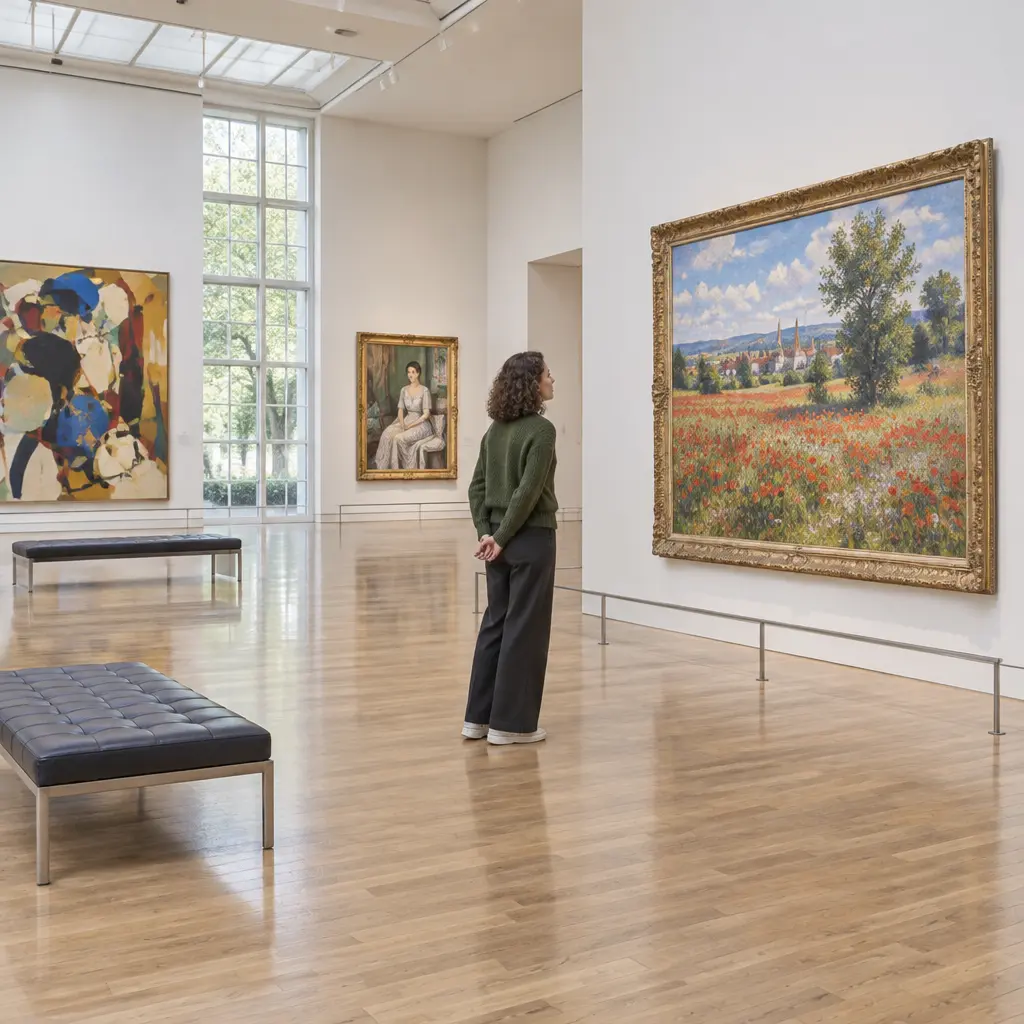
A work’s physical setting is part of the viewing experience. Step back to take in its overall composition, then move closer—while respecting barriers and museum instructions—to examine details. Notice whether the artwork seems intimate or monumental, whether its frame or pedestal changes your perception, and how lighting, neighboring works, and room architecture influence what you see. For example, a small portrait viewed at close range may feel conversational, while a large installation can make the viewer conscious of their own body in the room.
Use Time as a Viewing Tool
There is no required amount of time to spend with each object, but a deliberate pause can reveal details missed in a hurried pass. A 2001 study by psychologist James J. F. Smith and colleagues, published in Psychology of Aesthetics, Creativity, and the Arts, examined how museum visitors viewed paintings and found that viewing behavior varied with factors such as the work and the visitor. Rather than treating any single duration as a rule, use a timer only as a gentle prompt: look, pause, and revisit the work after reading its label.
How Interpretation Builds Art Appreciation in a Gallery
Interpretation is the process of forming and testing ideas about an artwork’s subject, purpose, context, and effects. The Getty Research Institute’s work on art-historical study shows why context matters: objects can be understood through evidence about their makers, materials, audiences, and historical circumstances. Interpretation is not a guessing contest with one hidden answer. It is a reasoned reading that distinguishes visible evidence from personal inference and remains open to revision.
Read Labels as Evidence, Not as a Substitute for Looking
Wall labels and exhibition texts can identify an artist, title, date, medium, provenance, or historical setting. Read them after forming an initial impression, then return to the artwork and ask what the information clarifies or complicates. A label may explain that a material was unusual for its time or that a work was made for a particular audience. It can deepen your view, but the artwork’s visual qualities remain worth examining directly.
Connect the Artwork to Its Historical and Cultural Context
Context includes the social conditions, traditions, technologies, and power relationships surrounding an artwork’s creation and display. Ask who made the work, who commissioned or owned it, what audience it addressed, and whose perspective may be absent from the exhibition. The Smithsonian’s National Museum of African Art, for example, emphasizes the importance of presenting works within the diverse cultural and historical contexts in which they were created, rather than treating them as detached objects.
Keep uncertainty visible. If a label does not answer a question, treat it as a question for further learning rather than filling the gap with assumptions. This is especially important when encountering art from cultures or periods unfamiliar to you.
Use Questions to Develop an Interpretation
Open-ended questions help connect observation to meaning. Try asking:
- What do I notice first, and what makes it stand out?
- What evidence in the work supports my interpretation?
- What might the artist want the viewer to feel, notice, or question?
- How does the title, material, or historical context change my reading?
- What remains ambiguous, and why might that ambiguity matter?
These questions echo inquiry-based museum education approaches, including the Visual Thinking Strategies method, which invites viewers to describe what they see, explain what they see that supports an idea, and consider what more they can find. The method makes discussion accessible without requiring prior art-history training.
How Personal Response and Conversation Enrich Art Appreciation in a Gallery
A personal response is a viewer’s emotional, sensory, or intellectual reaction to an artwork. It is a legitimate part of appreciation, but it becomes more useful when paired with careful looking and openness to other perspectives. The Institute of Museum and Library Services has documented museums’ roles in learning and community life, while visitor research commonly identifies social interaction as one part of the museum experience. A gallery visit can therefore be both an individual encounter and a shared activity.
Name Your Reaction and Trace Its Source
Notice whether a work makes you curious, calm, uncomfortable, amused, or confused. Then ask what feature prompted that response: a color contrast, a face, a scale shift, a subject, or a memory it evokes. You do not have to like every artwork to appreciate it. Discomfort or dislike can lead to valuable questions about the work’s choices, its context, or your expectations.
Discuss Art Without Turning Conversation into a Quiz
When viewing with someone else, compare observations before debating conclusions. One person may notice a repeated shape while another responds to the subject or mood. Ask what details led each person to their reading, and allow multiple interpretations to coexist when the evidence supports them. For a family or group visit, invite everyone to choose one detail they would show someone who had not seen the work.
Make Room for Accessibility and Different Ways of Seeing
Gallery appreciation does not depend on standing for long periods, seeing every detail, or reading every label. Museums may offer seating, audio description, large-print materials, tactile resources, quiet spaces, or guided tours; availability varies, so check the institution’s visitor information. The National Endowment for the Arts’ research on arts participation underscores that engagement takes many forms. Choose the supports and pace that make the visit comfortable and meaningful for you.
How a Practical Visit Plan Improves Art Appreciation in a Gallery
A simple plan reduces decision fatigue and leaves more attention for the art. Large museums can be tiring, so trying to see everything often works against close looking. The American Alliance of Museums and individual museum visitor guides commonly encourage visitors to plan around interests, time, and practical needs rather than treating a collection as a checklist.
Choose a Focus and Pace the Visit
Before entering, choose a theme, period, medium, or a small number of galleries. If you have limited time, select a few works for sustained attention and allow the rest of the visit to remain exploratory. Take breaks, use available benches, and return to a work that continues to interest you. A short, attentive visit can be more satisfying than a rushed attempt to cover every room.
Use a Repeatable Viewing Routine
- Look at the artwork before reading its label.
- Describe visible details, materials, and composition.
- Identify your immediate reaction and what may have caused it.
- Read the label or exhibition text for context.
- Return to the work and revise or deepen your interpretation.
- Record one question, detail, or idea to remember afterward.
A pocket notebook or a brief voice memo can help preserve observations, subject to the gallery’s photography and recording rules. Avoid touching artworks unless an institution explicitly provides a tactile experience, and follow instructions about bags, food, flash photography, and barriers.
Example: Applying the Method to a Portrait
Imagine encountering a portrait in which the sitter looks away from the viewer. First, notice the direction of the gaze, the pose, clothing, background, brushwork, and scale. Next, describe your response: perhaps the sitter seems distant or self-possessed. Then read the label for the artist, date, and any information about the sitter or commission. Finally, return to the painting: does the historical information support your first impression, challenge it, or leave important questions open? The process joins visual evidence, personal response, and context without assuming a single definitive reading.
Conclusion: Make Art Appreciation in a Gallery an Attentive Practice
Art appreciation in a gallery grows through slow looking, evidence-based interpretation, personal response, conversation, and a visit plan suited to your needs. Observe form and setting before drawing conclusions, use labels to add context, and treat questions or uncertainty as productive parts of viewing. You do not need expert knowledge or a particular reaction to engage meaningfully with art. On your next visit, choose one work, give it your full attention, and note what you see before deciding what it means. For further learning, explore a museum’s collection essays, visitor resources, and accessible tours.
Sources: American Alliance of Museums, “Museum Facts,” https://www.aam-us.org/programs/about-museums/museum-facts/; Berger, John, Ways of Seeing, Penguin Books, 1972, https://www.penguinrandomhouse.com/books/; Smithsonian National Museum of African Art, “About the Museum,” https://africa.si.edu/about/; Visual Thinking Strategies, “VTS Basics,” https://vtshome.org/what-is-vts/; Institute of Museum and Library Services, “Museums, Libraries, and Communities,” https://www.imls.gov/; National Endowment for the Arts, “Arts Participation Patterns in 2022,” https://www.arts.gov/impact/research/arts-data-profile-series; Smith, James J. F., et al., research on museum visitors’ viewing behavior, Psychology of Aesthetics, Creativity, and the Arts, 2001.