
How Artists Benefit From Gallery Exhibitions
A gallery exhibition is a public or invitation-based presentation of artworks in a curated setting. For artists, exhibiting can create visibility, professional relationships, sales opportunities, and feedback—but these benefits depend on the exhibition’s audience, organization, and fit with the artist’s goals. The National Endowment for the Arts reported that 48% of U.S. adults attended visual or performing arts events in person in 2022, evidence of a substantial potential audience, though not a measure of gallery attendance alone. Understanding how exhibitions build recognition, connect artists with buyers and peers, and support career development helps artists choose opportunities strategically.
Gallery Exhibitions Expand Artist Visibility and Recognition
Artist visibility is the degree to which an artist’s work and name reach relevant audiences, including viewers, curators, collectors, critics, and other artists. An exhibition makes a body of work publicly accessible in a physical or online setting, where visitors can encounter the work directly rather than through reproductions. The National Endowment for the Arts’ 2022 Survey of Public Participation in the Arts found that 48% of adults attended at least one in-person arts event during the year. That broad measure does not isolate gallery visitors, but it illustrates the continuing scale of in-person arts participation.
Exhibitions vary in format and reach. A solo exhibition centers one artist; a group exhibition presents several artists; a juried show selects work through a review process; and a museum or institutional exhibition may bring scholarly attention and a wider public profile. Each offers a different route to recognition, so artists should consider audience and context rather than treating every exhibition as equally valuable.
Direct Encounters Build a Memorable Artist Identity
A gallery gives viewers the chance to see an artwork’s scale, surface, material, and installation in person. These qualities can be difficult to convey through a screen or printed image. Curatorial interpretation, wall labels, and a coherent arrangement can also help visitors understand how individual works relate to an artist’s larger practice. The result can be stronger recognition of both the work and the person who made it.
Exhibition Records Strengthen Professional Credibility
An exhibition history is a record of where and when an artist has shown work. Artists often use it in résumés, grant applications, portfolios, and proposals to demonstrate experience and professional activity. The value of a listing depends on the venue and the exhibition’s relevance; a carefully chosen local or artist-run show can be more useful than an opportunity that reaches an unrelated audience. Accurate documentation—such as installation photographs, a checklist, and a dated exhibition page—helps preserve that record.
Gallery Exhibitions Create Connections and Career Opportunities
Professional networking is the development of relationships that support artistic practice, exhibition opportunities, learning, or sales. Exhibitions bring artists into a shared setting with curators, gallery staff, collectors, writers, fellow artists, and community organizations. The U.S. Bureau of Labor Statistics describes networking and portfolio development as practical parts of how fine artists promote their work and seek commissions or exhibition opportunities. A show can therefore function as both a public presentation and a meeting point for future collaborations.
Conversations Can Lead to New Collaborations
Opening receptions, artist talks, and guided tours give artists opportunities to explain their process and hear how audiences interpret the work. These conversations may lead to invitations, studio visits, partnerships, or referrals. Their value is not guaranteed: artists can make them more productive by preparing a concise description of their practice, asking visitors about their interests, and following up appropriately after the event.
Curatorial Feedback Helps Refine the Work
Curatorial feedback is informed commentary about an artist’s work, selection, presentation, or relationship to a broader artistic context. A curator may help identify connections among works, suggest a clearer installation, or introduce the artist to relevant audiences. Peer and visitor responses can also reveal which aspects of a work communicate effectively. Feedback is most useful when artists treat it as evidence to consider—not as a requirement to change their practice to satisfy every opinion.
Gallery Exhibitions Support Sales and Audience Development
Audience development means building sustained relationships with people who engage with an artist’s work, whether as viewers, subscribers, supporters, or buyers. An exhibition can help audiences discover an artist, learn about the work, and return to follow later projects. It can also create a setting for sales, commissions, and conversations about pricing. However, exhibiting does not guarantee income: sales depend on factors such as audience fit, affordability, presentation, promotion, and the terms agreed with the venue.
In-Person Viewing Can Support Art Sales
A physical exhibition allows prospective buyers to assess details that photographs may not show clearly, including texture, finish, and scale. Gallery staff can provide context and explain availability, while a checklist or price list makes the purchasing process clearer. Artists should confirm commission rates, payment schedules, insurance responsibilities, shipping arrangements, and the handling of unsold work before agreeing to exhibit.
Exhibitions Turn One-Time Visitors into Ongoing Audiences
A visitor becomes part of an artist’s audience when the person has a way to keep up with future work. With permission and in accordance with privacy rules, artists can invite visitors to follow a newsletter or professional social account, or direct them to a portfolio. The National Endowment for the Arts’ finding that nearly half of U.S. adults attended an in-person arts event in 2022 provides broader context for the potential of live cultural engagement, while an artist’s own visitor counts and follow-up responses offer more relevant measures of a particular show.
Gallery Exhibitions Build Skills and Inform Artistic Practice
Exhibition experience is practical knowledge gained by preparing, installing, presenting, and documenting artwork for an audience. These tasks help artists learn how works behave in a space, how lighting affects color and form, and how visitors move through an installation. The experience can also expose logistical gaps before they become larger problems in future projects.
Installation Develops Presentation Skills
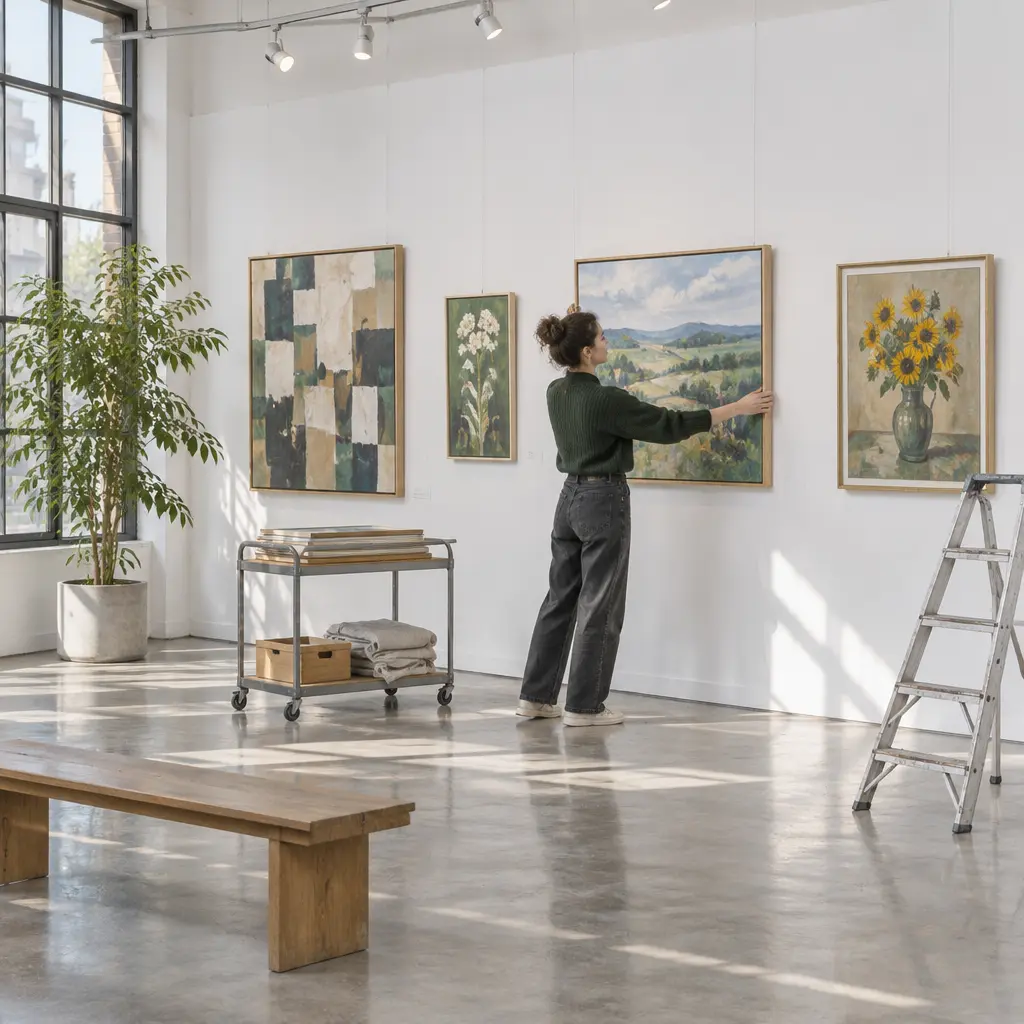
Installation is the process of arranging and securing artwork in a venue. Artists may need to plan measurements, hanging systems, lighting, labels, accessibility, and the sequence in which visitors encounter the work. A successful installation supports the artwork while making the space safe and understandable. Documenting the final arrangement also gives artists material for portfolios and future proposals.
Audience Responses Offer Useful, Limited Evidence
Audience response includes visitors’ questions, attention, interpretations, and reactions. It can help artists notice whether a display is legible or whether supporting information is needed. Yet a small group of visitors is not a representative survey, and immediate reactions should not be mistaken for definitive judgments about an artwork’s merit. Artists can combine informal observations with practical measures—such as attendance, inquiries, and sales—to assess whether an exhibition met its stated aims.
Choosing an Exhibition That Benefits an Artist
An exhibition is most beneficial when its audience, venue, costs, and expectations align with the artist’s objectives. Before accepting, artists can research the gallery’s previous shows, clarify promotional responsibilities, and request a written agreement covering fees, commissions, insurance, installation, and sales. They should also weigh less visible costs, including framing, transport, time away from paid work, and possible travel.
- Define the primary goal: recognition, sales, feedback, networking, or experience.
- Check whether the venue’s audience and program suit the work.
- Confirm all financial and practical terms in writing.
- Prepare a clear artist statement, checklist, and portfolio documentation.
- Evaluate outcomes against the original goal rather than sales alone.
For example, a first-time artist may prioritize a well-organized community gallery show to gain installation experience and build a documented exhibition record. An established artist preparing a new series might instead seek a gallery whose curatorial program reaches collectors or writers interested in that work. These are strategic examples rather than guaranteed outcomes: the best opportunity is the one that offers credible benefits without disproportionate cost or risk.
Conclusion: Gallery Exhibitions Benefit Artists in Multiple Ways
Gallery exhibitions can expand recognition, create professional connections, support sales and audience development, and build practical skills. Their benefits range from direct encounters with viewers to a stronger exhibition record and valuable experience presenting work. Because no show guarantees sales or career advancement, artists should choose opportunities according to their goals, assess the venue and terms carefully, and document what they learn. Artists considering an exhibition can start by reviewing local gallery programs, asking about written agreements, and identifying the outcomes they most want from the experience.
Sources: National Endowment for the Arts, “Arts Participation Patterns in 2022: Highlights from the Survey of Public Participation in the Arts,” https://www.arts.gov/impact/research/publications/arts-participation-patterns-2022-highlights-survey-public-participation-arts; U.S. Bureau of Labor Statistics, “Fine Artists, Including Painters, Sculptors, and Illustrators,” Occupational Outlook Handbook, https://www.bls.gov/ooh/arts-and-design/craft-and-fine-artists.htm.