
How Galleries Help Artists Build Their Careers
Art galleries help artists build careers by connecting their work with buyers, curators, critics, and wider audiences. They can provide exhibition opportunities, professional guidance, marketing, and access to collectors—support that matters in a U.S. arts economy where artists often combine multiple jobs and income sources. The National Endowment for the Arts’ Arts and Cultural Production Satellite Account estimated that arts and cultural production contributed $1.1 trillion, or 4.2% of U.S. GDP, in 2022; that figure describes the sector as a whole, not gallery sales alone. Understanding how galleries select artists, promote exhibitions, develop sales, and build reputations helps artists judge what a gallery relationship can—and cannot—do for their careers.
How Galleries Build Artists’ Careers Through Representation and Access
A gallery is an organization or business that presents and interprets artworks, often arranging exhibitions and facilitating sales. There is no single definition of gallery representation that applies to every agreement. In practical terms, representation is a working relationship in which a gallery promotes an artist and may handle agreed-upon activities such as exhibiting, communicating with clients, and selling work. The Smithsonian American Art Museum’s overview of the art market describes galleries as intermediaries that connect artists, collectors, and institutions; an individual gallery’s services and obligations depend on its practices and contract.
Gallery types include commercial galleries, nonprofit and university galleries, artist-run spaces, and cooperative galleries. Their goals differ: a commercial gallery may focus on sales and collector development, while a nonprofit gallery may prioritize public programming, experimentation, or education. Artists should therefore assess a gallery’s audience and mission rather than assume every exhibition provides the same kind of career support.
Representation and professional partnership
Representation means that an artist and a gallery agree on how they will work together. It may be exclusive or nonexclusive, limited to a region or medium, or focused on a particular exhibition. A written agreement can clarify commission, pricing, payment timing, insurance, shipping, marketing, and whether the gallery has the right to sell work outside its own premises. Because practices vary, artists should review the terms carefully and seek legal or professional advice when needed.
A gallery relationship can also provide professional feedback. Gallery staff may help an artist select work for an exhibition, prepare an artist statement, or plan a coherent presentation. This guidance can improve how the work is introduced to audiences, but it does not guarantee sales, representation elsewhere, or long-term income. Artists retain responsibility for evaluating whether the gallery’s expertise and audience fit their goals.
Access to collectors and institutions
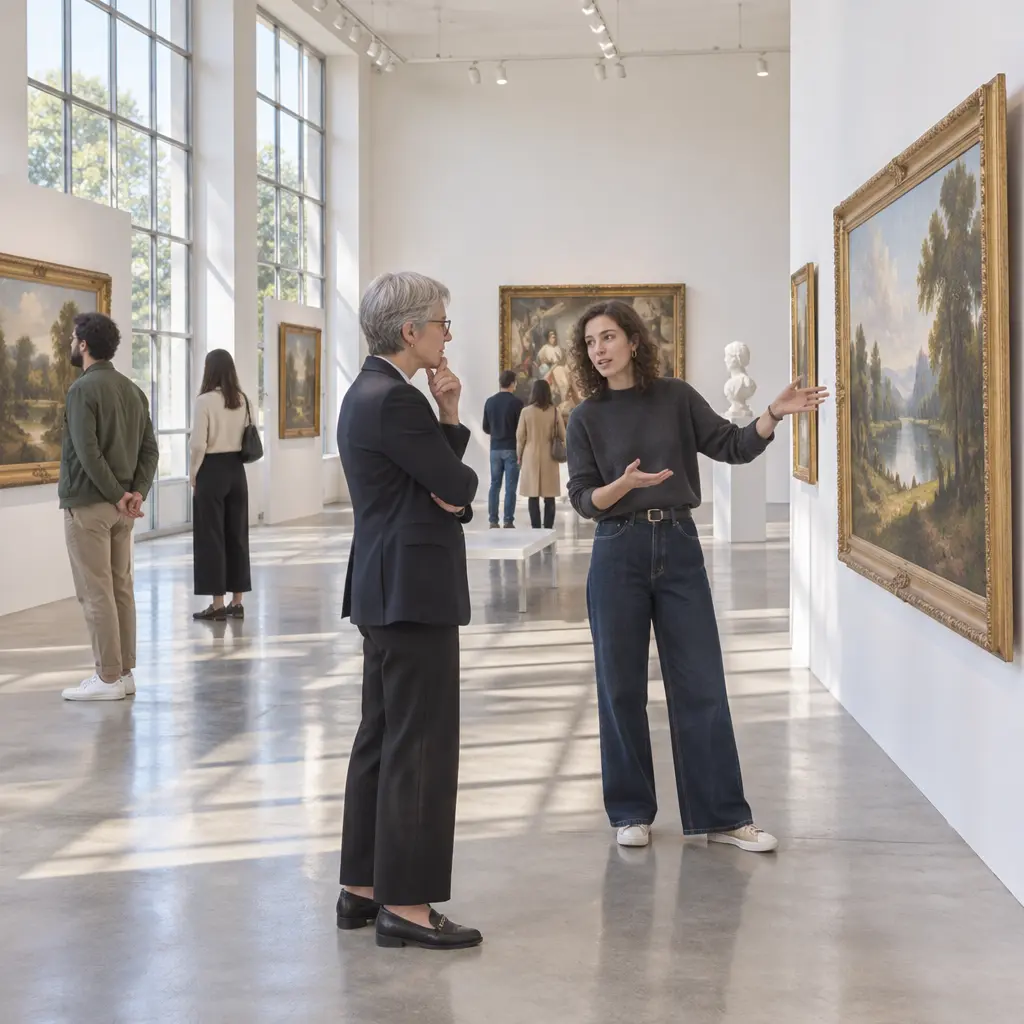
Galleries can introduce artists to collectors, curators, museum staff, and other arts professionals. These relationships may lead to repeat purchases, invitations, loans, or institutional consideration. An exhibition also gives visitors a chance to see work in person, which is especially valuable for art whose scale, surface, or installation is difficult to judge through photographs.
Access is not the same as guaranteed advancement. A gallery’s network varies by location, specialty, and reputation, and an introduction does not ensure an acquisition or commission. Artists can assess access by asking who attends openings, what kinds of clients the gallery serves, and how it has supported artists at a similar career stage.
How Gallery Exhibitions Build Artists’ Visibility and Reputation
An exhibition is a public presentation of artworks, often organized around an artist, theme, or collection. For artists, exhibitions can create visibility, establish a record of professional activity, and give audiences a focused opportunity to encounter the work. The value depends on factors such as the gallery’s audience, the quality of presentation, and the follow-up after the show.
Solo, group, and juried exhibitions
A solo exhibition concentrates attention on one artist’s work, while a group exhibition places several artists in a shared context. Juried exhibitions select work through a review process, sometimes led by an independent curator or panel. Each format offers different benefits: a solo show can communicate an artist’s direction in depth, while a group show may introduce the work to new audiences or connect it with a particular theme.
Exhibition history can strengthen an artist’s biography and support applications for grants, residencies, or future shows. However, the number of exhibitions alone is a weak measure of career progress. Artists should also consider whether a show reaches relevant viewers, documents the work well, and contributes meaningfully to their artistic development.
Curation, interpretation, and documentation
Curation is the process of selecting and arranging artworks, often with supporting interpretation such as wall text, catalog essays, or public talks. Thoughtful curation helps viewers understand relationships among works without dictating a single interpretation. Professional photographs, installation images, and a clear exhibition record can also help artists document their practice for portfolios, press, and future opportunities.
The gallery’s communications can extend an exhibition beyond its physical audience through press outreach, newsletters, social media, and online viewing materials. These tools are most useful when they accurately describe the work and reach people likely to engage with it. A large online following, by itself, does not establish that an exhibition has produced meaningful professional or financial results.
How Galleries Support Artists’ Sales and Income
Sales support includes presenting work to potential buyers, explaining its context, negotiating transactions, and coordinating delivery. Galleries may also advise on pricing and maintain relationships with collectors. These services can reduce the administrative burden on artists, but they involve costs and do not remove the uncertainty of art-market income.
Pricing, commissions, and clear agreements
A commission is the portion of a sale paid to the gallery under the parties’ agreement. Rates and terms vary, so artists should not rely on a presumed industry standard. Before consigning work, they should confirm the retail price, commission calculation, payment deadline, responsibility for taxes and shipping, insurance coverage, and what happens to unsold work. Consistent pricing across direct and gallery sales can also help preserve trust with buyers and the gallery.
The U.S. Copyright Office explains that copyright protection generally arises when an original work is fixed in a tangible form, although copyright ownership and transfer depend on the facts and any applicable agreement. A sales or representation contract should distinguish ownership of the physical artwork from copyright and specify whether the gallery may reproduce images for promotion. Artists can consult the Copyright Office and a qualified adviser for situation-specific guidance.
Collector relationships and repeat sales
Collectors may return to an artist’s work over time, and galleries can help maintain those relationships by sharing new work, arranging studio visits, and providing accurate information about an artist’s practice. A successful relationship can create repeat sales, but artists should avoid treating a single sale as proof of stable demand. Keeping records of sales, expenses, inventory, and client permissions helps artists understand the financial results of gallery activity.
The broader labor context makes this caution important. The U.S. Bureau of Labor Statistics reports that the median annual wage for craft and fine artists was $56,260 in May 2023, while also noting that many artists hold another job because earnings from art can be irregular. This occupational statistic is not a measure of gallery-supported income; it illustrates why artists often need diversified revenue and realistic financial planning.
How Galleries Help Artists Develop Skills and Networks
Career development includes building practical knowledge, professional relationships, and the ability to sustain an artistic practice. Galleries can contribute through feedback, introductions, and public-facing opportunities. These benefits are strongest when they complement an artist’s independent work rather than substitute for it.
Professional feedback and career planning
Gallery staff may offer feedback on presentation, portfolio selection, framing, installation, and communication with buyers. Such advice can help artists understand how their work is received and identify practical improvements. Artists should distinguish constructive expertise from pressure to change their practice solely to satisfy short-term market preferences.
A gallery may also help an artist plan a sequence of exhibitions or prepare for a studio visit. Still, career decisions remain the artist’s responsibility. Comparing opportunities across galleries, nonprofit spaces, residencies, grants, and direct sales can help prevent overdependence on a single relationship.
Peer networks and community participation
Group shows and gallery events bring artists into contact with peers, curators, writers, and arts organizations. These encounters can support collaboration and exchange of knowledge. Artist-run and cooperative galleries may be particularly useful for building local community, though participation can require members to contribute time, funds, or administrative work.
For example, an emerging artist in a cooperative space might gain exhibition experience and peer feedback while helping organize events. A commercial gallery, by contrast, may provide more direct access to buyers but expect a different level of sales readiness. Neither model is automatically superior: the useful choice depends on an artist’s goals, resources, and stage of practice.
How Artists Can Evaluate a Gallery Relationship
Evaluating a gallery means looking beyond its reputation or appearance to determine whether its practices, audience, and terms support the artist’s goals. The National Endowment for the Arts’ research on the arts economy provides useful context about the sector’s scale, but artists should evaluate an individual gallery using direct evidence and clear questions.
Questions to ask before signing or consigning
- What services will the gallery provide, and which promotional activities are included?
- What commission, payment schedule, and expense responsibilities apply?
- How are artworks insured while stored, displayed, or shipped?
- Is the arrangement exclusive, and what territory or period does it cover?
- How are unsold works returned, and who pays for their return shipping?
- May the gallery use images of the work, and for what promotional purposes?
- Can the artist speak with artists who have previously worked with the gallery?
Warning signs and practical safeguards
Unclear fees, pressure to sign immediately, missing inventory records, vague payment terms, or promises of guaranteed success warrant closer scrutiny. Artists can protect themselves by documenting each artwork’s title, dimensions, medium, condition, and agreed price; keeping copies of contracts and correspondence; and confirming delivery and return arrangements in writing. These basic records reduce confusion even in a positive working relationship.
A gallery should be judged by the match between its claims and its actual practices. Artists can review exhibition records, inspect how works are installed and described, ask about audience engagement, and clarify how sales and promotion are reported. A carefully chosen gallery can be a valuable partner, but it is one part of a broader career strategy that may include grants, commissions, teaching, residencies, and direct engagement with audiences.
Conclusion: Galleries as Partners in Sustainable Art Careers
Galleries help artists build careers by offering representation, exhibitions, access to collectors, sales support, professional feedback, and connections with arts communities. Their impact varies by gallery type and agreement, and no exhibition or sales relationship guarantees long-term success. The U.S. arts and cultural sector’s $1.1 trillion contribution to GDP in 2022 underscores the broader economic significance of the arts, while labor data remind us that many artists face irregular income.
Artists can make gallery partnerships more effective by defining their goals, comparing the gallery’s audience and track record, documenting work and transactions, and reviewing written terms before committing. For further research, consult the National Endowment for the Arts’ arts-economy reports, the U.S. Bureau of Labor Statistics’ artist occupation data, and the U.S. Copyright Office’s guidance. Treat a gallery as a potential collaborator—not a guarantee—and build a resilient career through multiple relationships and income sources.
Sources: National Endowment for the Arts, Arts and Cultural Production Satellite Account, https://www.arts.gov/impact/research/arts-data-profile-series/adp-34; U.S. Bureau of Labor Statistics, Occupational Outlook Handbook: Craft and Fine Artists, https://www.bls.gov/ooh/arts-and-design/craft-and-fine-artists.htm; U.S. Copyright Office, Copyright Basics, https://www.copyright.gov/what-is-copyright/; Smithsonian American Art Museum, Art Market, https://americanart.si.edu/art/art-market.