
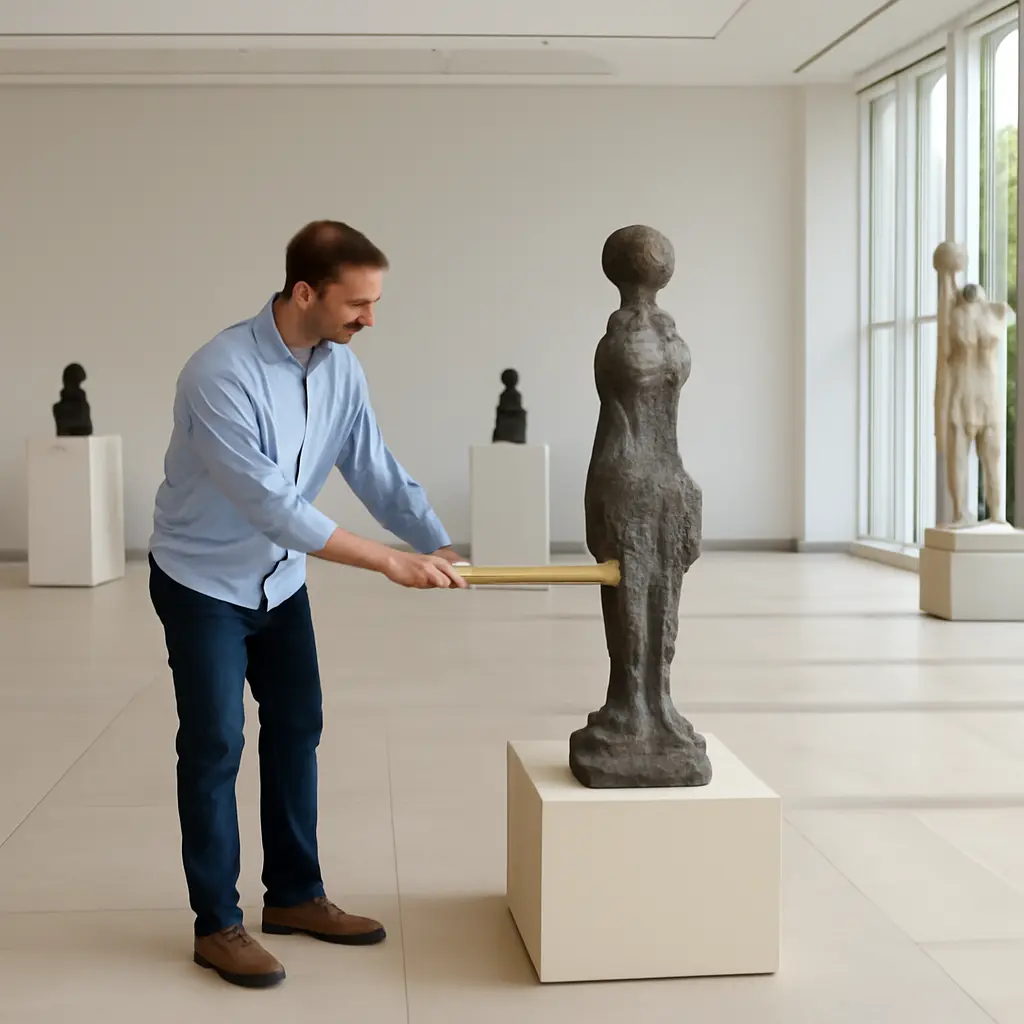
What Happens When You Ignore Proper Sculpture Display Spacing
Sculpture display spacing is the planned distance between an artwork and nearby visitors, walls, objects, and circulation routes. Ignoring it can make sculptures harder to see, increase collision and handling risks, and weaken the visual relationships that help viewers understand them. There is no single spacing rule for every work: appropriate placement depends on a sculpture’s size, materials, stability, sightlines, visitor flow, and conservation needs. Museum guidance from organizations including the Smithsonian Institution and the Canadian Conservation Institute emphasizes assessing those factors together, while accessibility standards provide measurable requirements for clear routes. This guide explains how spacing supports interpretation, safety, conservation, and inclusive access, and offers practical ways to assess an installation.
Visitor circulation and sculpture display spacing
Sculpture display spacing is the deliberate arrangement of objects and the open areas around them. It includes the viewing distance in front of a work, separation from neighboring works, clearance from walls, and the width of routes visitors use to move through a gallery. The Smithsonian’s museum-planning and exhibition guidance treats circulation, sightlines, accessibility, and object protection as interconnected design considerations; spacing is therefore not simply an aesthetic preference.
A useful starting point is to distinguish between a work’s visual envelope—the space viewers need to see and interpret it—and its safety envelope—the area needed to prevent accidental contact and allow staff to maintain it. These envelopes differ by object. A small bronze may need a secure case and enough separation to read its form, while a large projecting sculpture may require a broader buffer and an unobstructed approach from more than one direction.
Viewing distance and sightlines
Viewing distance is the space that allows a visitor to perceive a sculpture’s overall form and, where relevant, its surface details. If a work is placed too close to a wall or another object, visitors may lose important viewpoints; if it is too far from an intended viewing area, details can become difficult to examine. Curators and exhibition designers commonly test sightlines from seated and standing positions, from entrances, and from the points where visitors are likely to pause.
There is no universally correct viewing distance because scale, lighting, room size, and artistic intent vary. A practical installation review can mark several possible viewing positions on a floor plan, then check whether each offers a clear view without blocking circulation. For a sculpture meant to be seen in the round, the plan should also allow visitors to move around it rather than treating it as a wall-bound object.
Clear routes and accessible approach
A circulation route is the space kept clear for visitors to travel through an exhibition. In the United States, the 2010 ADA Standards for Accessible Design specify a minimum clear width of 36 inches (915 millimeters) for an accessible walking surface, with limited exceptions; a 60-inch (1,525-millimeter) turning space is one common way to provide wheelchair turning clearance. These are accessibility benchmarks, not recommended sculpture-to-sculpture distances, and local requirements may differ.
When a sculpture, plinth, queue, or interpretive label intrudes into a route, visitors may have to detour, pass too close to the artwork, or compete for space. Measure the clear path after all display elements are installed, not just on the original floor plan. Also consider people using mobility devices, visitors with canes or strollers, and groups who pause together; a route that technically meets a minimum can still feel congested in practice.
Safety and conservation consequences of poor sculpture spacing
Inadequate spacing creates avoidable opportunities for contact, impact, vibration, and accidental tipping. The Canadian Conservation Institute’s preventive-conservation guidance describes physical forces, inappropriate handling, and environmental conditions as risks to collections. A crowded layout can compound those risks: visitors may brush a projecting element, bags may strike a pedestal, or staff may lack room to clean and inspect an object safely.
Collision, tipping, and visitor injury risks
A collision risk arises when visitors or objects in motion can contact a sculpture, its base, or a neighboring display. Risk increases when a work has fragile protrusions, an unstable center of gravity, a low profile that is difficult to notice, or a location beside a narrow turning point. The result can be damage to the artwork as well as injury to visitors, so spacing decisions should be made alongside mount design, anchoring, barriers, and supervision.
Before opening, staff can conduct a walk-through that simulates ordinary movement: entering with a group, turning a wheelchair, stopping to read a label, and passing someone who is already viewing the work. If these actions bring people into contact with the display, the solution may involve moving the sculpture, widening the route, changing the plinth, or adding a discreet protective boundary. The appropriate control depends on the object and the venue’s risk assessment.
Cleaning, inspection, and emergency access
Maintenance clearance is the working space conservators and facilities staff need to inspect, clean, monitor, and respond to problems around an object. A sculpture pressed against a wall may conceal dust, pest activity, moisture, or damage, while a tightly packed display can make safe handling and emergency removal more difficult. The Smithsonian and conservation institutions advise planning for care and access as part of exhibition design rather than treating them as afterthoughts.
The required clearance depends on the work’s material and installation. A heavy stone sculpture may need equipment access for relocation; a delicate mixed-media work may require a controlled environment and minimal disturbance. Establish maintenance requirements with the conservator, registrar, and installation team, and record any access restrictions in the exhibition plan.
Interpretation and visual relationships between sculptures
Spacing also shapes meaning. The distance between works can encourage comparison, establish a sequence, or give an object visual prominence. When sculptures are crowded without a clear interpretive purpose, their forms may compete, labels can become difficult to associate with the correct work, and visitors may not know where to look first. Conversely, excessive separation can fragment a thematic group or make a small object feel disconnected from its context.
Grouping, contrast, and visual hierarchy
Visual hierarchy is the way an exhibition guides attention among objects. Designers can use spacing to distinguish a featured work from supporting pieces, create pauses between themes, or invite viewers to compare related forms. The right arrangement is not necessarily symmetrical: a deliberate cluster can be effective when the objects share a meaningful connection and each remains visible and safely accessible.
A useful test is to ask whether a visitor can identify the intended relationship from the room itself, without relying entirely on labels. If neighboring silhouettes overlap from common viewpoints, or one object visually masks another, adjust the angle or separation. A simple plan-view diagram can show the sculpture footprints, expected viewing positions, and circulation paths; a companion sightline sketch can reveal visual conflicts that a floor plan alone misses.
Crowding, dwell time, and visitor experience
Crowding occurs when the number of people and the available viewing space make it difficult to approach, pause, or move comfortably. A narrow area around a popular sculpture can become a bottleneck, especially when visitors stop to photograph it or read nearby text. The U.S. Access Board’s dimensional guidance helps designers plan accessible routes, but real visitor comfort should also be checked under expected attendance conditions.
Museums can assess congestion through timed observations, visitor-flow counts, and staff feedback during busy periods. These measures are more useful than assuming a fixed number of inches will suit every gallery: attendance, group size, school visits, and event use all change how much open space is needed. If a display repeatedly causes queues to block a route, consider relocating the work or label, creating a separate viewing zone, or changing the approach direction.
Planning and evaluating sculpture display spacing
Effective spacing is established through a documented process that combines object information, accessibility checks, conservation advice, and on-site testing. A floor plan is a useful start, but it cannot fully predict how visitors will behave or how a sculpture will read from every position. For that reason, exhibition teams should validate the arrangement in the actual room before installation is finalized.
A practical pre-opening spacing review
Use the following review to identify common problems before visitors enter:
- Record the sculpture’s dimensions, weight, fragile features, support requirements, and intended viewing angles.
- Mark the object, plinth, case, label, and any protective barrier on the exhibition plan.
- Measure accessible routes and turning areas after accounting for every display element.
- Check sightlines from standing and seated positions, including the gallery entrance and likely visitor approach.
- Simulate visitor movement and pauses, paying special attention to projecting forms, corners, and bottlenecks.
- Confirm that conservators and facilities staff can inspect and maintain the work safely.
- Reassess the layout during a busy period and revise it if crowding or contact risks appear.
Real-world application: a crowded gallery display
Consider a gallery where a freestanding sculpture sits between a wall label and a narrow route to the next room. Visitors approaching the work stop in the passage, while others squeeze around its plinth. The problem is not solved simply by moving the label: the team should evaluate the sculpture’s safe buffer, the accessible path, the best viewing direction, and whether the work can be shifted into a wider area. A revised layout might orient the sculpture toward the room, relocate the label to an approach point, and preserve a clear route around the display.
This example illustrates why spacing is a systems decision. A small change in position can improve the view, reduce contact risk, and prevent a circulation pinch point at the same time. The final arrangement should be verified with the conservator and accessibility lead, then observed with visitors so the team can respond to actual use.
Conclusion: why proper sculpture display spacing matters
Proper sculpture display spacing supports clear sightlines, accessible circulation, safer visitor movement, and responsible collection care. Poor spacing can hide important visual relationships, create bottlenecks, increase contact risks, and make inspection or maintenance harder. The most reliable approach is to plan visual and safety envelopes for each object, apply applicable accessibility standards, consult conservation professionals, and test the arrangement in the gallery.
For your next display, measure routes after installation, walk the space from multiple viewpoints, and observe how people actually move and pause. Consult the relevant accessibility authority and your institution’s conservator for project-specific requirements; the sources below provide useful starting points for further reading.
Sources: U.S. Department of Justice, 2010 ADA Standards for Accessible Design, https://www.ada.gov/law-and-regs/design-standards/2010-stds/; U.S. Access Board, Guide to the ADA Accessibility Standards, https://www.access-board.gov/ada/guides/; Smithsonian Institution, Smithsonian Guidelines for Accessible Exhibition Design, https://www.si.edu/accessibility/exhibition-design; Canadian Conservation Institute, Agents of Deterioration, https://www.canada.ca/en/conservation-institute/services/agents-deterioration.html