
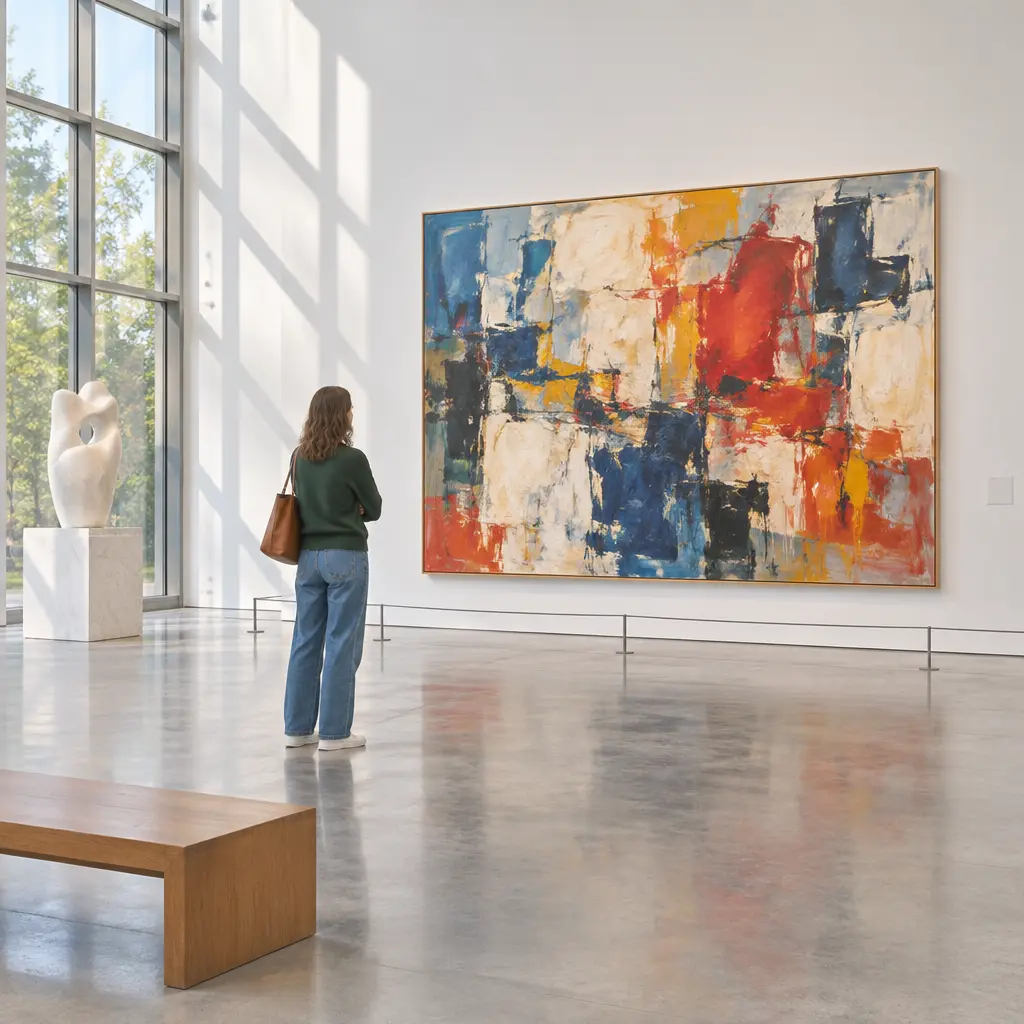
Abstract Art Interpretation Building Personal Connection Beyond Technical Understanding
Abstract art is art that does not depend on recognizable subjects to communicate; it uses elements such as color, shape, line, texture, and composition. Building a personal connection with it does not require mastering its techniques or discovering a single “correct” meaning. Instead, viewers can notice their reactions, relate visual choices to memory and feeling, and remain open to interpretations that change over time. This approach matters because art is encountered widely but often feels intimidating: the National Endowment for the Arts’ 2022 Survey of Public Participation in the Arts found that 48% of U.S. adults attended an arts event in person during the prior year, while museums and educators continue to explore how looking and discussion can support engagement. The sections below define personal connection in abstract-art viewing, explain emotional and observational approaches, consider interpretation and cultural context, and offer a practical method for looking more closely.
Personal Connection in Abstract Art: Definition and Meaning
A personal connection to abstract art is the meaning or response a viewer develops through attentive looking and reflection, rather than through identifying a depicted object alone. It may include an emotion, memory, sensory impression, question, or association. The phrase is a useful description of a viewing process, not a standardized psychological measure. The Museum of Modern Art’s educational materials on looking at art emphasize observation and interpretation as related but distinct activities: viewers first attend to what they can see, then consider what those details might suggest.
That distinction makes room for uncertainty. A viewer can accurately describe a painting’s colors and forms without yet feeling connected to it; conversely, a work can prompt a strong response before the viewer can explain its construction. Neither response is a test of artistic knowledge. Technical understanding can deepen an encounter, but it is not a prerequisite for one.
Observation before interpretation
Observation means naming visible features without immediately deciding what they symbolize. A viewer might notice a dense cluster of dark marks, a large unpainted area, or a repeated curve. Interpretation then considers how these features affect the experience: the dark cluster may feel heavy, while the open space may seem calm or isolated. Separating the two helps viewers ground personal meaning in what is actually present in the work.
Personal meaning without a single correct answer
Personal interpretation is not the claim that every reading is equally supported. An interpretation becomes more thoughtful when it can be connected to visible evidence, the work’s title or materials, and relevant historical context. A viewer may experience a painting as joyful even if another sees tension; discussing the contrasting colors, irregular marks, or composition gives both responses something concrete to explore.
Emotional and Sensory Responses Build Personal Connection
Once viewers begin with observation, they can pay attention to the physical and emotional effects of the work. Abstract art often foregrounds qualities—such as rhythm, contrast, scale, and texture—that viewers can experience before assigning them a narrative. These responses are individual, but they are not detached from the artwork: a reaction may be prompted by the painting’s actual visual organization.
Emotional response
An emotional response is a feeling associated with viewing, such as unease, delight, boredom, curiosity, or calm. Naming the feeling can provide a starting point rather than a final verdict. Ask what might be contributing to it: Is the image crowded or spacious? Are its colors muted or intense? Does the eye move smoothly, or does it keep getting interrupted? The University of Texas at Austin’s Visual Thinking Strategies approach, developed by Abigail Housen and Philip Yenawine, uses open-ended questions—including “What’s going on in this picture?” and “What do you see that makes you say that?”—to encourage viewers to connect interpretations with evidence.
Sensory attention to color, form, and rhythm
Sensory attention focuses on how visual elements feel to the eye and body. Repeated marks may create a sense of pulse; sharp angles may seem forceful; a broad field of color may feel enveloping. These are responses, not universal laws: the same red may suggest warmth to one person and alarm to another. Instead of treating color symbolism as fixed, notice how color operates in this specific work and how your associations influence what you see.
Memory and association
Association occurs when an image brings to mind a place, event, object, or experience. A viewer might connect a layered surface to a city wall or a sweeping blue shape to a remembered coastline. Such associations can make viewing personally meaningful, even when the artist had something else in mind. It helps to phrase them as possibilities—“this reminds me of”—rather than as claims about what the artwork definitively depicts.
Interpretation Connects Visual Evidence with Context
A personal reading becomes richer when it is placed alongside the artwork’s making and history. Context does not cancel a viewer’s response; it gives that response more dimensions. Abstract art is not one unified style: it includes movements and practices with different aims, from geometric abstraction to gestural painting and color-field work.
Technique as a clue, not a barrier
Technique describes how an artwork was made, including its materials, marks, and processes. Learning that an artist used thin washes, thick impasto, collage, or repeated gestures may help explain a surface’s visual effect. The technique is valuable context, but viewers do not need to identify every process before responding. A practical question is: “What does this way of making do to my experience of the image?”
Artist, title, and historical context
A title, date, artist statement, or museum label can redirect interpretation by revealing an intention or historical setting. The Museum of Modern Art’s collection includes works by artists such as Piet Mondrian and Jackson Pollock, whose approaches to abstraction differ substantially: Mondrian is associated with carefully organized grids and primary colors, while Pollock is known for poured and dripped paint. These examples show why “abstract art” should not be treated as a single visual language. Use contextual information to ask better questions, while allowing your own initial response to remain part of the encounter.
Cultural perspective and interpretive humility
Viewers bring cultural knowledge, personal histories, and assumptions to art. Those perspectives can reveal connections that others miss, but they can also shape what seems familiar or strange. When a work draws on a specific cultural tradition, its context deserves attention rather than being reduced to a viewer’s private symbolism. A responsible interpretation distinguishes what the viewer feels from what is documented about the artist, community, or tradition.
A Practical Method for Connecting with Abstract Art
A simple viewing routine can make an unfamiliar work more approachable. The steps below combine careful description, reflection, and context without requiring specialist vocabulary.
- Spend a minute looking before reading the label. Notice the whole composition, then choose one area to inspect closely.
- Name three visible details, such as a repeated shape, a sharp contrast, or a change in texture.
- Identify your immediate response. If you feel nothing in particular, note that honestly and keep looking.
- Ask what visual evidence might contribute to that response. Consider scale, color, balance, direction, and empty space.
- Allow an association or memory to emerge, but distinguish it from a factual claim about the artist’s intention.
- Read the label or seek reliable context, then notice whether the new information changes or complicates your reading.
For example, a viewer standing before a large, densely marked painting might first describe its overlapping lines. They may then notice that the marks pull the eye in several directions, experience the work as energetic, and connect that sensation to a crowded street. Learning about the artist’s process could add another layer without making the personal association invalid. The experience develops through observation, response, and reconsideration.
Conclusion: Let Looking Lead to Connection
Personal connection with abstract art begins not with decoding a hidden answer but with paying attention. Observation provides visual evidence; emotional and sensory responses make the encounter personal; and technique, history, and cultural context can deepen interpretation. A viewer does not need to understand every artistic choice to find meaning, and a first impression need not be the last. Choose one abstract artwork, spend a few quiet minutes with it, and record what you notice, feel, and wonder. Returning to it later may reveal how both the artwork and your own interpretation have changed.
Sources: National Endowment for the Arts, 2022 Survey of Public Participation in the Arts, https://www.arts.gov/impact/research/publications/2022-survey-public-participation-arts; Museum of Modern Art, Art Terms: Abstraction, https://www.moma.org/learn/moma_learning/themes/what-is-modern-art/abstraction/; Visual Thinking Strategies, About VTS, https://vtshome.org/about/; Museum of Modern Art, Piet Mondrian and Jackson Pollock collection and artist resources, https://www.moma.org/artists/4057 and https://www.moma.org/artists/4675.