
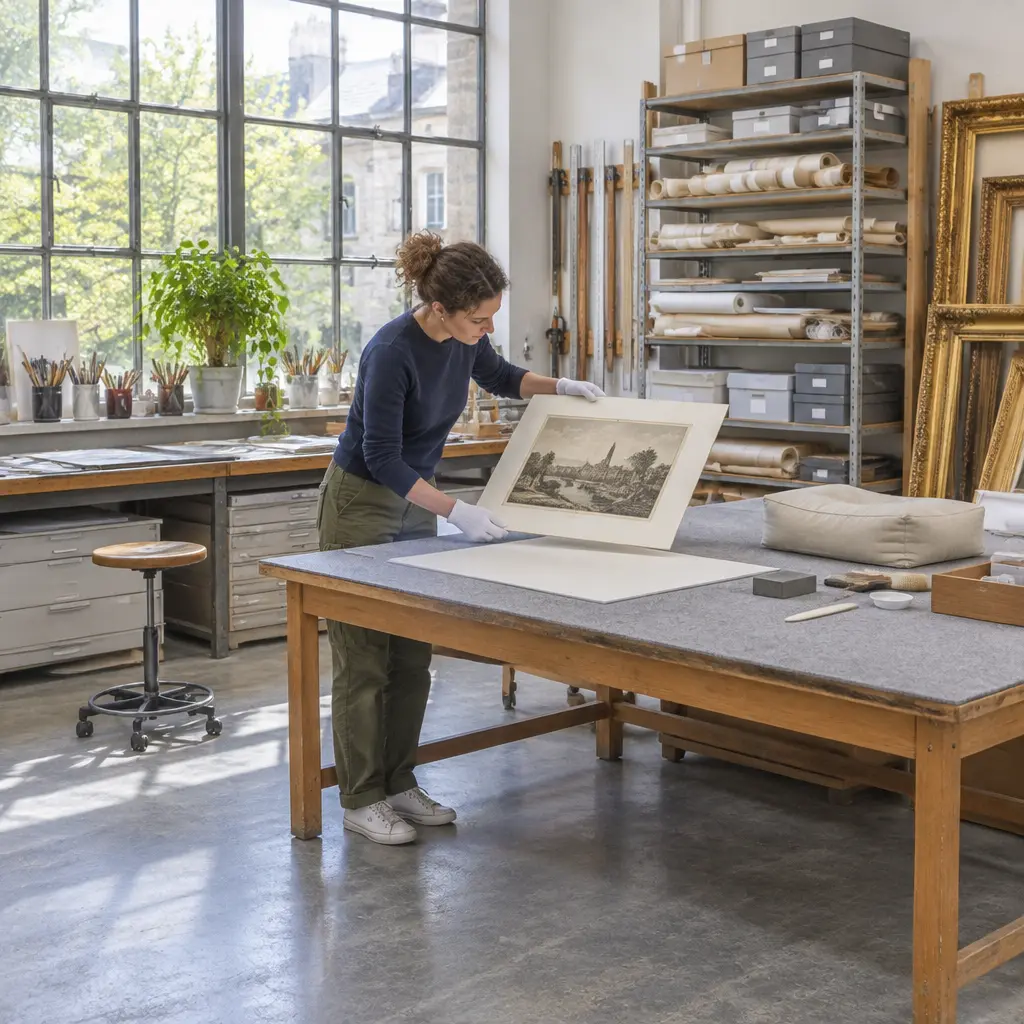
Archival Framing Standards Preventing Acid Migration Through Material Specification
Archival framing standards prevent acid migration by specifying chemically stable materials between a work of art and its frame, backing, glazing, and attachments. The key is not simply to label a frame “archival,” but to select and assemble components that limit contact with acidic wood, paper, adhesives, and pollutants. The Library of Congress recommends preservation-quality enclosures and materials that are chemically stable, while conservation guidance from the Canadian Conservation Institute (CCI) emphasizes that harmful substances can migrate through direct contact or exposure to emissions. These standards matter because acidic materials can discolor, embrittle, or stain paper and photographs over time; this article explains migration, material specifications, component choices, and practical inspection steps.
Acid migration and archival framing material specification
Acid migration is the movement of acidic compounds from one material into or onto another. In framing, the source may be acidic paperboard, wood, adhesive, or a deteriorating artwork component; the recipient may be paper, a photograph, textile, or other sensitive object. CCI describes deterioration risks arising when incompatible materials are in contact, and conservation practice therefore treats framing as a system rather than a collection of individually marketed products.
The word “archival” does not, by itself, certify a universal performance level. Specifications should instead identify measurable properties and intended uses: for example, acid-free and lignin-free boards for paper-based works, suitable buffering where appropriate, and a barrier that prevents direct contact with wood. The Library of Congress advises using preservation-quality materials and avoiding acidic materials in contact with collection items. A conservation-grade design also considers humidity, pollutants, light, adhesives, and the object’s own chemical stability.
Direct-contact migration
Direct-contact migration occurs when an acidic support or backing touches the artwork. Acidic wood-pulp board can transfer acidic compounds to paper, causing yellowing, weakening, and eventual embrittlement. The risk is especially relevant to works mounted against inexpensive backing board or stored in acidic mats. A window mat and backing made from appropriate conservation board create a buffer, but they must be specified for the object rather than chosen by appearance alone.
Migration through emissions and adjacent materials
Some damaging compounds can move through air within a frame package, even without direct contact. Wood and certain finishes, sealants, and adhesives may emit volatile compounds; pollutants can also accumulate in a poorly designed enclosure. CCI’s guidance on pollutants and enclosure materials supports allowing for both contact and airborne pathways. A barrier between the artwork and frame components, combined with tested, low-emission materials, reduces exposure but does not eliminate the need for suitable environmental conditions.
Conservation board standards for archival framing
Conservation board is a paper-based support used for mats and backing. Its specification commonly addresses acidity, lignin content, and alkaline reserve. The Picture Framing Industry’s voluntary standards, including standards developed through the Fine Art Trade Guild, distinguish levels of mounting-board quality; conservation professionals also rely on material testing and object-specific judgment. A board’s marketing name alone is not evidence of compliance, so buyers should request the stated standard or technical data.
Acid-free and lignin-free board
“Acid-free” generally means the board has a neutral or alkaline pH when tested, but the term does not necessarily describe its long-term stability. Lignin, a natural component of wood, can break down into acidic products; removing it helps reduce a potential source of deterioration. For works on paper, use board documented as both acid-free and lignin-free, and confirm that the product is intended for conservation use rather than ordinary decorative framing.
Buffered and unbuffered board
Buffered board contains an alkaline reserve, often calcium carbonate, designed to neutralize acids that may form or migrate over time. The reserve is useful for many paper objects, but it is not suitable for every material. Some photographs, color processes, and other sensitive items may be harmed by alkaline conditions, so conservators may specify unbuffered board or an appropriate barrier layer. The correct choice depends on the object’s medium and condition, not on a blanket rule that buffered board is always superior.
Board thickness, surface, and documented testing
A board must also be structurally suitable: it should support the object without flexing, have a surface compatible with the mounting method, and avoid abrasive contact. Technical specifications should identify the board’s pH, lignin status, buffering, and applicable testing or industry standard. For valuable or fragile works, a conservator can assess whether the board, hinges, and enclosure are compatible as a complete assembly.
Frame barriers and backing materials that limit acid transfer
Even when a frame is made of wood, the artwork need not touch it. A conservation package separates the object from the frame and backing using suitable mats, spacers, barriers, and a sealed or protective back where appropriate. This layered design addresses the main pathways of transfer while also protecting against dust and handling. It is particularly important because framing materials can remain in contact with an object for years or decades.
Barrier layers between artwork and wood
A barrier layer is a stable sheet or film placed between potentially harmful frame components and the artwork package. Conservation practice may use suitable metal foil laminates or other tested barrier products to reduce the passage of acidic emissions from wood. The barrier must be installed continuously and without exposing the artwork to adhesive residues. Its suitability should be confirmed for the specific frame construction and conservation purpose.
Backboards and dust covers
A backing board protects the frame package from physical damage and dust, but ordinary corrugated board or acidic hardboard can introduce harmful materials. Choose a stable backing specified for conservation use, and avoid allowing raw wood or an acidic backing to touch the art or its mounting board. A dust cover can reduce particulate entry, but it is not a substitute for an appropriate barrier or a controlled display environment.
Spacers, glazing, and adhesives
Spacers keep glazing from touching the artwork, preventing abrasion and condensation-related contact. Glazing choices also affect light exposure: the Canadian Conservation Institute notes that light damage is cumulative and irreversible, so ultraviolet filtering can help but cannot make bright or prolonged display harmless. Mounting adhesives should not be applied directly to an original unless a conservator has determined that the method is appropriate. Reversible paper hinges and conservation-approved tapes are generally preferred for many works on paper.
Material choices for paper, photographs, and mixed-media objects
The same framing recipe does not suit every collection item. Paper, photographic processes, textiles, and mixed-media works differ in their sensitivity to acidity, alkalinity, moisture, and adhesive contact. The Library of Congress recommends storage and handling practices appropriate to the material, while conservation institutions advise evaluating the object’s composition and condition before selecting an enclosure. This makes material identification a necessary step before ordering a frame.
Works on paper
For drawings, prints, and documents, conservation-grade, lignin-free mat and backing boards help reduce acid transfer and provide physical support. The artwork should be attached in a way that minimizes permanent alteration, often with reversible hinges made from suitable paper and adhesive. If the sheet is brittle, torn, or already discolored, framing should be planned with a paper conservator rather than relying on a standard retail mounting package.
Photographs and color-sensitive materials
Photographs require special attention because processes differ in their response to alkaline materials, pollutants, and light. Some photographic materials may call for unbuffered, chemically stable enclosures; others may tolerate different conditions. The Image Permanence Institute’s preservation resources emphasize that temperature and relative humidity strongly affect photographic stability, while light exposure contributes to fading. Identify the process when possible and consult a photograph conservator for valuable or unusual images.
Textiles and mixed-media works
Textiles and mixed-media objects may contain dyes, metals, plastics, adhesives, or acidic papers in the same piece. These materials can react differently to buffers, pressure, and enclosure conditions. A textile should not be compressed between mat and glazing, and three-dimensional elements may require a deeper frame and inert supports. Where the object’s composition is uncertain, a conservator can identify risks and recommend a compatible material stack.
Implementation, inspection, and real-world preservation practice
Effective archival framing combines material selection with assembly quality and ongoing care. Museums and libraries use preventive-conservation practices because deterioration is often gradual and difficult to reverse. The Library of Congress notes that suitable storage and handling can significantly extend the usable life of collections; the same principle applies to framed objects, which should be protected from heat, moisture, direct sun, and pollutant sources.
A practical specification checklist
Before framing, record the object type and condition, then specify materials by properties rather than vague labels. A basic checklist includes:
- Use conservation-grade, lignin-free mat and backing boards with documented pH and buffering status.
- Select buffered or unbuffered board according to the artwork’s medium and conservator guidance.
- Prevent direct contact between the artwork and wood, acidic backing, unsuitable adhesive, or glazing.
- Use tested barriers or spacers where needed to separate the object from frame components.
- Document product names, technical specifications, and assembly details for future maintenance.
Inspection and environmental controls
Inspect framed objects periodically for brown edges, yellowing, foxing, warped backing, condensation, loose hinges, or changes in odor. These signs do not prove acid migration on their own, but they warrant investigation. Avoid hanging valuable works on damp exterior walls, above radiators, or in direct sunlight. The CCI recommends stable environmental conditions for collections; managing temperature and relative humidity reduces risks from chemical and physical deterioration alike.
Case example: reframing an acidic backing
A common preservation intervention is the reframing of a print whose original package includes acidic cardboard or wood directly behind the sheet. A conservator removes the harmful backing, examines the paper for staining and brittleness, and installs a stable conservation board with a suitable barrier and reversible mounting. The intervention does not erase prior damage, but it removes a continuing source of risk and makes future condition checks easier. This illustrates why material specification matters as much as the frame’s external appearance.
Conclusion: specify materials, not just an “archival” label
Archival framing prevents acid migration by reducing direct contact and emissions exposure through appropriate conservation board, barriers, backing, spacers, and mounting methods. Acid-free and lignin-free board is a useful baseline for many works on paper, but buffering must be selected for the object’s medium. Because “archival” is not a universal guarantee, request technical specifications, document the materials used, and consult a conservator for fragile, valuable, or chemically complex objects. Better material choices preserve both the object and the ability of future viewers to study it; for further guidance, consult the Library of Congress, the Canadian Conservation Institute, and a qualified paper or photograph conservator.
Sources: Library of Congress, Care, Handling, and Storage of Works on Paper, https://www.loc.gov/preservation/care/paper.html; Canadian Conservation Institute, Caring for Paper Objects, https://www.canada.ca/en/conservation-institute/services/conservation-preservation-publications/canadian-conservation-institute-notes/caring-paper-objects.html; Canadian Conservation Institute, Agents of Deterioration: Pollutants, https://www.canada.ca/en/conservation-institute/services/agents-deterioration/pollutants.html; Canadian Conservation Institute, Agents of Deterioration: Light, Ultraviolet and Infrared, https://www.canada.ca/en/conservation-institute/services/agents-deterioration/light.html; Image Permanence Institute, Graphics Atlas and Preservation Resources, https://www.graphicsatlas.org/